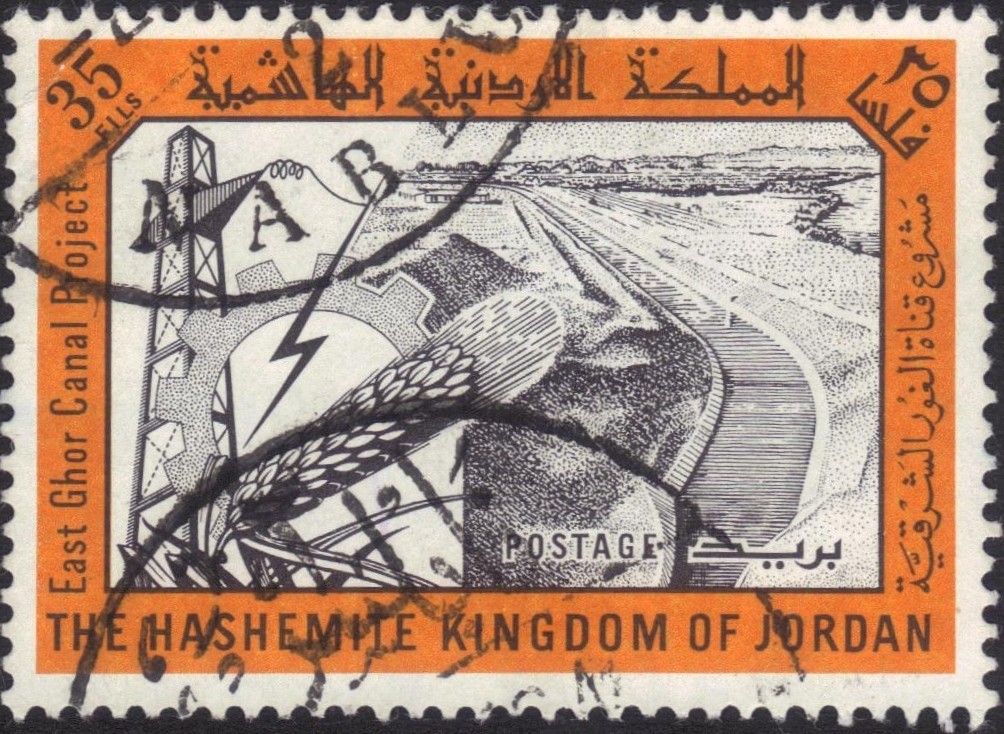
East Ghor Canal Project - 35 fils
The East Ghor Canal (later renamed the King Abdullah Canal / قناة الملك عبد الله) was a monumental hydraulic engineering initiative undertaken by Jordan beginning in 1959. Designed to divert water from the Yarmouk River along the eastern slope of the Jordan Valley (Ghor), the extensive concrete-lined aqueduct system was engineered to transform vast tracts of arid land into fertile, year-round agricultural terrain. The project represented a cornerstone of Jordan's post-independence economic development, providing essential irrigation for staple crops and citrus orchards while securing a vital supply of fresh water for the growing nation.
The composition highlights the key elements of national infrastructure, modernization, and agrarian progress. The right side presents a perspective view of the engineered canal stretching through the cultivated fields of the Jordan Rift Valley toward distant hills. On the left, symbolic emblems of development an electrical transmission tower, an industrial cogwheel, a lightning bolt for hydroelectric power, and an ear of wheat represent the integration of technology, energy, and agriculture powering Jordan's mid-century expansion.
The composition highlights the key elements of national infrastructure, modernization, and agrarian progress. The right side presents a perspective view of the engineered canal stretching through the cultivated fields of the Jordan Rift Valley toward distant hills. On the left, symbolic emblems of development an electrical transmission tower, an industrial cogwheel, a lightning bolt for hydroelectric power, and an ear of wheat represent the integration of technology, energy, and agriculture powering Jordan's mid-century expansion.