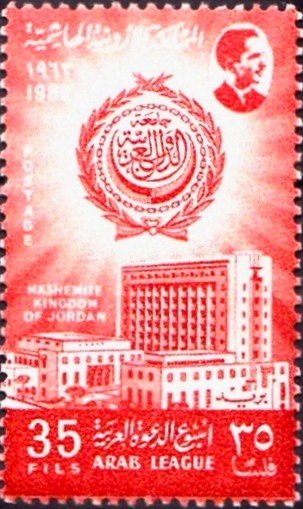
Arab League Week - 35 fils
The Arab League (League of Arab States / جامعة الدول العربية) was founded in Cairo on March 22, 1945, to foster economic, cultural, political, and social cooperation among independent Arab nations and mediate regional affairs. The Hashemite Kingdom of Jordan was among the six founding member states that signed the Alexandria Protocol and the League's foundational charter. In 1962, member states organized designated cultural and diplomatic initiatives—such as Arab League Week (أسبوع الدعوة العربية)—to promote regional solidarity, pan-Arab cooperation, and common civic aspirations across the Middle East and North Africa.
The issue brings together core symbols of regional unity and Hashemite statehood. At the upper center sits the official emblem of the Arab League, encircled by laurel branches and chains representing the unified member nations, with a portrait of young King Hussein of Jordan featured in the upper right. Below, the design depicts the modern headquarters of the Arab League Secretariat located in Tahrir Square, Cairo, highlighting Jordan’s active participation in inter-Arab diplomacy and multilateral institutions during the mid-20th century.
The issue brings together core symbols of regional unity and Hashemite statehood. At the upper center sits the official emblem of the Arab League, encircled by laurel branches and chains representing the unified member nations, with a portrait of young King Hussein of Jordan featured in the upper right. Below, the design depicts the modern headquarters of the Arab League Secretariat located in Tahrir Square, Cairo, highlighting Jordan’s active participation in inter-Arab diplomacy and multilateral institutions during the mid-20th century.