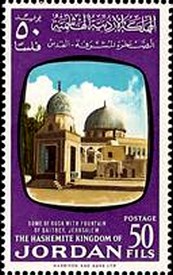
Dome of the Rock with Fountain of Qaitbay - 50 fils
The Dome of the Rock (Qubbat al-Sakhrah / قبة الصخرة) sits at the heart of the Al-Aqsa Compound (Al-Haram Al-Sharif) on Mount Moriah in the Old City of Jerusalem. Completed in 691–692 CE under the Umayyad Caliph Abd al-Malik ibn Marwan, the shrine is venerated as the location of the Foundation Stone, the point from which the Prophet Muhammad is believed to have ascended to heaven during the miraculous Night Journey (Al-Isra' wal-Mi'raj). As one of the earliest and most celebrated masterpieces of Islamic architecture, its iconic octagonal ambulatory plan, extensive Quranic calligraphic friezes, and grand dome have made it a central spiritual symbol for centuries.
Situated directly west of the central platform is the Fountain of Qaitbay (Sabil Qaitbay / سبيل قايتباي), an ornate public drinking fountain constructed during the Mamluk era. Originally commissioned in 1455 by Sultan Inal and extensively rebuilt in 1482 by Sultan Al-Ashraf Qaitbay, it is celebrated as the only freestanding Mamluk domed structure outside Cairo. The sabil is distinguished by its intricate arabesque stonework, relief carvings, and decorated stone dome, exemplifying the extensive Mamluk patronage and urban embellishment of Jerusalem’s sacred landscape alongside the main sanctuary.
Situated directly west of the central platform is the Fountain of Qaitbay (Sabil Qaitbay / سبيل قايتباي), an ornate public drinking fountain constructed during the Mamluk era. Originally commissioned in 1455 by Sultan Inal and extensively rebuilt in 1482 by Sultan Al-Ashraf Qaitbay, it is celebrated as the only freestanding Mamluk domed structure outside Cairo. The sabil is distinguished by its intricate arabesque stonework, relief carvings, and decorated stone dome, exemplifying the extensive Mamluk patronage and urban embellishment of Jerusalem’s sacred landscape alongside the main sanctuary.